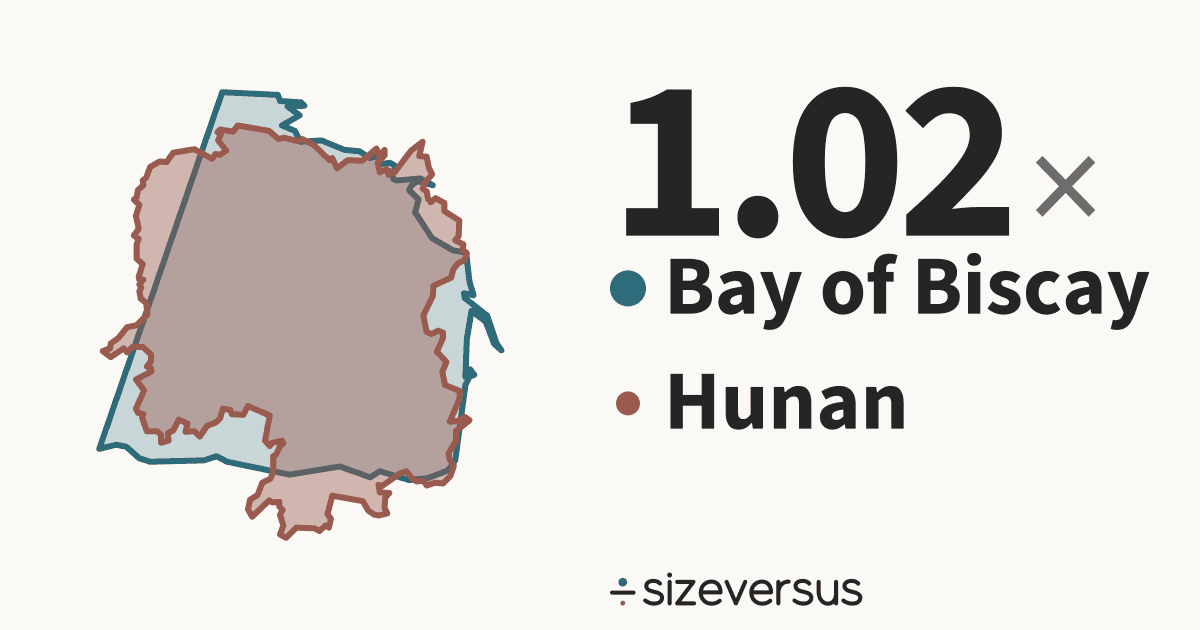
Bay of Biscay is 1.02× the size of Hunan
The Bay of Biscay (bay) covers about 216,000 km² (83,400 mi²) and Hunan (province) about 211,000 km² (81,600 mi²). Below, both outlines are drawn at one scale and centred on each other. The Bay of Biscay outline is Natural Earth’s, checked against the published area.
- 216,000km²Bay of Biscay
- 211,000km²Hunan
100 km
- Bay of Biscay
- Hunan
What fits
- Hunan is 98% of the size of Bay of Biscay.
- Bay of Biscay is larger by 4,720 km² (1,820 mi²), which is 2.2% of the area of Hunan.
- Measured in Belgiums: Bay of Biscay is about 7.05, Hunan about 6.89.
How they differ
- Their centres are about 9,640 km apart.
- A standard web map misstates the comparison: Bay of Biscay at 46°N is drawn about 2.0× too large and Hunan at 28°N about 1.3×, so the map shows Bay of Biscay as 1.64× the size of Hunan instead of 1.02×.
- Together Bay of Biscay and Hunan cover 427,000 km², close to the size of Iraq (437,000 km², 2.3% bigger).
- The gap between them, 4,720 km², is about the size of Trinidad and Tobago (5,120 km²).
- Bay of Biscay's centre is 17.9° of latitude, about 1,990 km, farther north than Hunan's.
- The Bay of Biscay is a bay and ranks 25th of the 42 seas on sizeversus by area.
- Hunan is a province of China; it is not drawn with its waters removed, and its measured area is the Natural Earth outline's.
- Laid out flat, the Bay of Biscay stretches about 571 km north to south and 592 km east to west; Hunan about 607 km by 539 km.
- Poured over Hunan, the 389,000 km³ that Wikidata records for the Bay of Biscay would stand 1,841 m deep.
- Our measured 216,000 km² is 3.1% below Wikidata’s published figure of 223,000 km². Published areas of lakes and seas move with the water level and with what is counted, so a few percent is expected.
Who wins on what
| Measure | Winner | By |
|---|---|---|
| Larger area | Bay of Biscay | 1.02× |
| Farther north | Bay of Biscay | 17.9° of latitude |
| Stretched more on a web map | Bay of Biscay | 2.0× against 1.3× |
Both against the same yardsticks
| Yardstick | Bay of Biscay | Hunan |
|---|---|---|
| Belgium 30,700 km² | 7.05× | 6.89× |
| United Kingdom 244,000 km² | 0.89× | 0.87× |
| Germany 358,000 km² | 0.60× | 0.59× |
| Japan 374,000 km² | 0.58× | 0.57× |
| France 548,000 km² | 0.39× | 0.39× |
| India 3,151,000 km² | 0.07× | 0.07× |
| Brazil 8,473,000 km² | 0.03× | 0.02× |
| United States 9,447,000 km² | 0.02× | 0.02× |
| Russia 16,980,000 km² | 0.01× | 0.01× |
Each figure is the place's area divided by the yardstick's.
Side by side
| Bay of Biscay | Hunan | |
|---|---|---|
| Is a | Baysea on sizeversus | ProvinceChina |
| Area, measured | 216,000 km²83,400 mi² | 211,000 km²81,600 mi² |
| Area, published | 223,000 km²Wikidata | 212,000 km²Wikidata |
| Rank by area | 25th of 42seas | – |
| Greatest depth | 4,735 mWikidata | – |
| Volume | 389,000 km³ | – |
| Latitude range | 43°N to 48°N | 25°N to 30°N |
| On the shore | 2 on the shore | – |
Published figures: Wikidata (CC0). A lake or a sea has no legal boundary: the measured area is that of Natural Earth’s outline, and it is shown beside the published one.
- Natural Earth’s outlines of France and Spain lie within 25 km of the outline of the Bay of Biscay. That is what its geometry says, and it is not a statement about who owns the water or where any border runs in it.
Similar in size to Bay of Biscay
Similar in size to Hunan
More comparisons
Send it to someone who won’t believe it

Sources and method
- Outlines
- Lakes and seas: Natural Earth 1:10m physical vectors (public domain), kept only where the measured area is within 10% of the published one. Countries and regions: Natural Earth, 1:10m Admin 0 and Admin 1, public domain.
- Boundary
- De facto, as drawn by Natural Earth. A lake or a sea has no legal boundary of its own; the outline is a cartographic one.
- Area
- Measured on the WGS84 ellipsoid from the full-detail outlines, shown rounded. The published figure comes from Wikidata (CC0), fetched 2026-11-11, and is shown beside the measured one.
- Drawing
- Each outline is projected with an equal-area projection centred on its own centroid, so areas stay true and the two can be laid over each other.
- Data built
- 2026-11-11