Europe · Western Europe
Germany
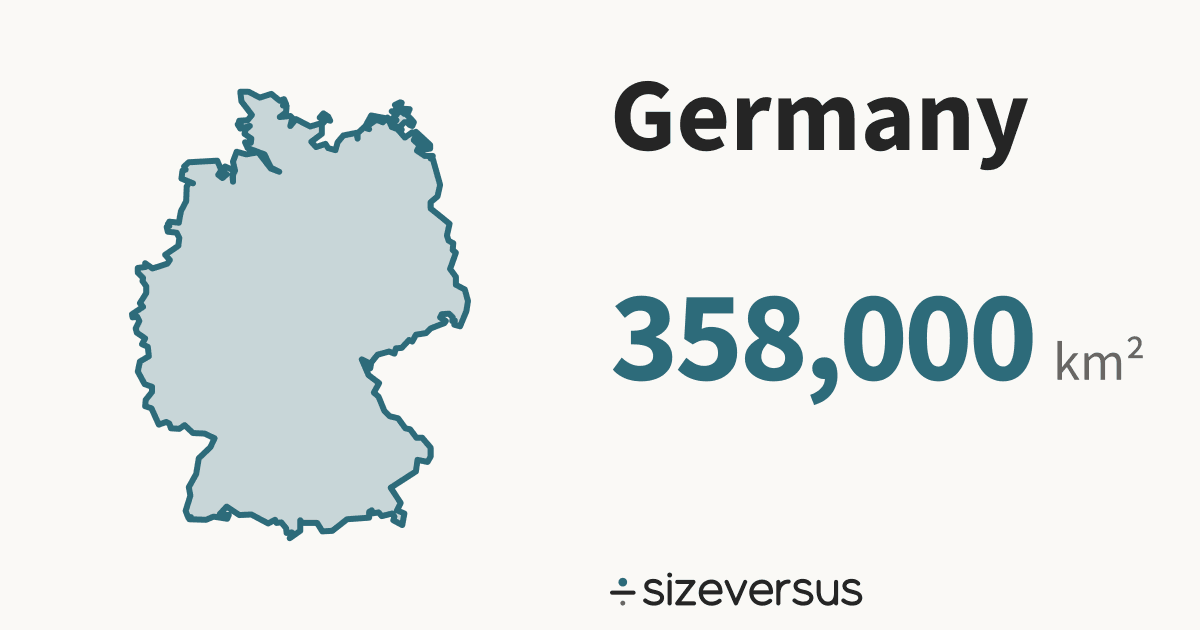
Germany covers about 358,000 km² (138,000 mi²), the 65th largest of the 246 places listed here. That is close to Republic of the Congo, at about 345,000 km².
- 358,000km²Area, main territory
- 83.5 millionPopulation
- 11.7In Belgiums
200 km
- Germany
Facts
| Area, main territory | 358,000 km²138,000 mi² |
|---|---|
| Official area | 358,000 km²Wikidata · agrees with our measure |
| In Belgiums | 11.7 |
| Capital | Berlin |
| Population | 83.5 millionWikidata, 2025 |
| Density | 233 people per km² |
| Latitude range | 47°N to 55°N |
| In other languages | Alemania Español · Deutschland Deutsch · Allemagne Français · Alemanha Português · ドイツ 日本語 · 德国 中文 · 독일 한국어 |
| Continent | Europe#7 of 50 countries by area |
What the numbers say about Germany
- Russia, the largest place listed, is 47.5× the size of Germany.
- Germany ranks 19th of 237 by population but only 64th of 239 by area: it holds more people than its size suggests.
- At 233 people per km², Germany is the 31st most densely populated of the 185 places over 1,000 km²; the median is 72 per km².
- On a standard web map (Web Mercator), a place at 51°N is drawn about 2.5× too large in area, so Germany looks bigger there than it is.
- Laid out flat, Germany's main territory stretches about 849 km north to south and 639 km east to west.
- Wikidata's official figure of 358,000 km² agrees with our measured area of 358,000 km², to within 2%.
How Germany measures up
Germany holds 1.6% of the land area and 11% of the people of the 50 countries listed for Europe. In Western Europe it is the 2nd largest of 9.
| Where it ranks | Figure | Position |
|---|---|---|
| Area | 358,000 km² | 64th of 239 |
| Population | 83.5 million | 19th of 237 |
| Density | 233 per km² | 31st of 185 |
| Farthest north | 51.0°N | 19th of 212 |
| Compared with | Its area | Germany is |
|---|---|---|
| Belgium | 30,700 km² | 11.7× its size |
| United Kingdom | 244,000 km² | 1.47× its size |
| Japan | 374,000 km² | 0.96× its size |
| France | 548,000 km² | 0.65× its size |
| India | 3,151,000 km² | 0.11× its size |
| Brazil | 8,473,000 km² | 0.04× its size |
| United States | 9,447,000 km² | 0.04× its size |
| Russia | 16,980,000 km² | 0.02× its size |
Where Germany sits
- Germany's centre lies at 51.0°N, 10.4°E, in the northern and eastern hemispheres, about 5,680 km from the equator.
- Its main territory spans 47°N to 55°N, about 870 km from its southern edge to its northern.
Closest neighbours, by distance between centres
On the same latitude, elsewhere in the world
If Germany had other densities
- At Bangladesh's density of 1,252 people per km², Germany would have 448.0 million people. It has 83.5 million.
- At Canada's density of 3.7 people per km², Germany would have 1.3 million people. It has 83.5 million.
- At the median density of the places listed, 72 per km², it would have 25.9 million.
States of Germany
Natural Earth’s file divides Germany into 16 states. Each has its own page, drawn at true size and matched to the countries closest to it in area and in people.
About the same size as
Largest in Europe
- Russia16,980,000 km²
- Ukraine572,000 km²
- France548,000 km²
- Spain499,000 km²
- Sweden446,000 km²
- Germany#7 · 358,000 km²
Compare Germany
Share this outline

Sources and method
- Outline
- Natural Earth, 1:10m Admin 0 - Countries, public domain
- Boundary
- De facto, as drawn by Natural Earth.
- Area
- Measured on the WGS84 ellipsoid from the full-detail outline, shown rounded
- Official figures
- Area, population and capital from Wikidata (CC0), fetched 2026-11-11
- Population
- Wikidata, 2025; covers the whole country, overseas territory included
- Data built
- 2026-11-11