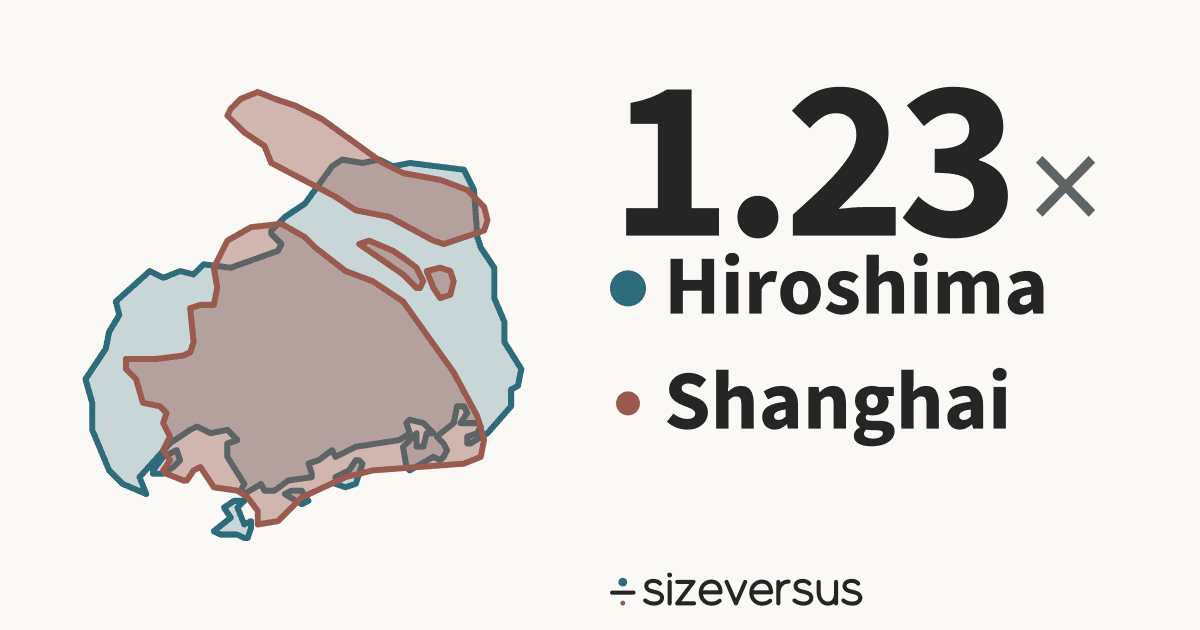
Hiroshima is 1.23× the size of Shanghai
Hiroshima (prefecture of Japan) covers about 8,300 km² (3,210 mi²) and Shanghai (municipality of China) about 6,750 km² (2,600 mi²). Below, both outlines are drawn at one scale and centred on each other.
- 8,300km²Hiroshima
- 6,750km²Shanghai
20 km
- Hiroshima
- Shanghai
What fits
- Shanghai is 81% of the size of Hiroshima.
- Hiroshima is larger by 1,560 km² (601 mi²), which is 23% of the area of Shanghai.
- Measured in Belgiums: Hiroshima is about 0.27, Shanghai about 0.22.
How they differ
- Hiroshima is larger, but Shanghai has the larger population: 24.9 million against 2.8 million, 8.91× as many people.
- Per square kilometre that is 3,687 in Shanghai against 336 in Hiroshima: Shanghai is 11.0× as densely populated.
- Their centres are about 1,120 km apart.
- Together Hiroshima and Shanghai cover 15,000 km², close to the size of East Timor (15,100 km², 0.2% bigger).
- The gap between them, 1,560 km², is about the size of Comoros (1,670 km²).
- At Shanghai's density, Hiroshima would have 30.6 million people (it has 2.8 million). At Hiroshima's density, Shanghai would have 2.3 million (it has 24.9 million).
- Hiroshima's centre is 3.4° of latitude, about 380 km, farther north than Shanghai's.
- Hiroshima is the 12th largest of the 47 prefectures of Japan and covers 2.2% of its area; it is the 16th most densely populated of them.
- Shanghai is the 31st largest of the 31 provinces and regions of China and covers less than 0.1% of its area; it is the most densely populated of them.
- Hiroshima lies about 3° of latitude (roughly 380 km) north of Shanghai.
- Shared out evenly, each person in Hiroshima would have about 2,970 m² and each person in Shanghai about 270 m².
- Laid side by side, Hiroshima and Shanghai would cover 15,000 km², about the same size as East Timor.
- Together they have 27.7 million people, about as many people as Australia.
Side by side
| Hiroshima | Shanghai | |
|---|---|---|
| Is a | PrefectureJapan | MunicipalityChina |
| Area, measured | 8,300 km²3,210 mi² | 6,750 km²2,600 mi² |
| Official area | 8,480 km²Wikidata | 6,340 km²Wikidata |
| Rank by area | 12th of 47in Japan | 31st of 31in China |
| Population | 2.8 millionWikidata, 2021 | 24.9 millionWikidata, 2020 |
| Rank by population | 12th of 47in Japan | 23rd of 31in China |
| Density | 336 per km² | 3,687 per km² |
| Capital | Hiroshima | – |
| Latitude range | 34°N to 35°N | 31°N to 32°N |
Population: Wikidata 2021 and Wikidata 2020. Official figures: Wikidata (CC0).
- Our measured 8,300 km² is 2.1% below Wikidata's official figure of 8,480 km². Official figures can include inland water or count land that an outline draws differently.
- Our measured 6,750 km² is 6.4% above Wikidata's official figure of 6,340 km². Official figures can include inland water or count land that an outline draws differently. This difference is flagged for review.
Similar in size to Hiroshima
Similar in size to Shanghai
More from the same country
More comparisons
Send it to someone who won’t believe it

Sources and method
- Outlines
- Natural Earth, 1:10m Admin 1 - States, Provinces, public domain
- Boundary
- De facto, as drawn by Natural Earth. A region is drawn whole, every island included; a country is its main territory.
- Area
- Measured on the WGS84 ellipsoid from the full-detail outlines, shown rounded.
- Drawing
- Each outline is projected with an equal-area projection centred on its own centroid, so areas stay true and the two can be laid over each other.
- Data built
- 2026-11-12