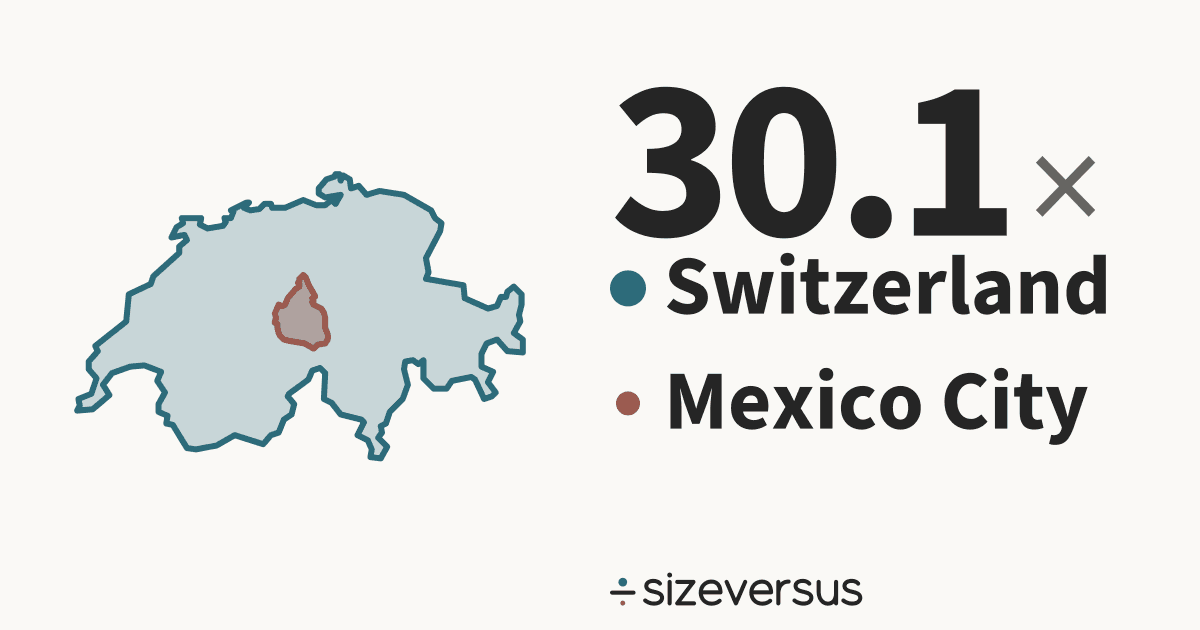
Switzerland is 30.1× the size of Mexico City
Switzerland (Europe) covers about 41,400 km² (16,000 mi²) and Mexico City (federal entity of Mexico) about 1,380 km² (531 mi²). Below, both outlines are drawn at one scale and centred on each other.
- 41,400km²Switzerland
- 1,380km²Mexico City
100 km
- Switzerland
- Mexico City
What fits
- Mexico City fits inside Switzerland about 30.1 times by area.
- Switzerland is larger by 40,100 km² (15,500 mi²), which is 2,913% of the area of Mexico City.
- Measured in Belgiums: Switzerland is about 1.35, Mexico City about 0.04.
How they differ
- Switzerland also has the larger population: 9.1 million against 8.9 million, 1.02× as many people.
- Per square kilometre that is 6,486 in Mexico City against 220 in Switzerland: Mexico City is 29.5× as densely populated.
- Their centres are about 9,700 km apart.
- A standard web map misstates the comparison: Switzerland at 47°N is drawn about 2.1× too large and Mexico City at 19°N about 1.1×, so the map shows Switzerland as 57.3× the size of Mexico City instead of 30.1×.
- Together Switzerland and Mexico City cover 42,800 km², close to the size of Denmark (42,700 km², 0.3% smaller).
- The gap between them, 40,100 km², is about the size of Bhutan (40,400 km²).
- At Mexico City's density, Switzerland would have 268.7 million people (it has 9.1 million). At Switzerland's density, Mexico City would have 302,000 (it has 8.9 million).
- Switzerland's centre is 27.5° of latitude, about 3,060 km, farther north than Mexico City's.
- Switzerland ranks 135th of 246 countries and territories by area.
- Mexico City is the 32nd largest of the 32 states of Mexico and covers less than 0.1% of its area; it is the most densely populated of them.
- Switzerland lies about 28° of latitude (roughly 3,060 km) north of Mexico City.
- Shared out evenly, each person in Switzerland would have about 4,550 m² and each person in Mexico City about 150 m².
- Laid side by side, Switzerland and Mexico City would cover 42,800 km², about the same size as Denmark.
- Together they have 18.0 million people, about as many people as the Netherlands.
- Mexico City is drawn from 42 points: at a size under 2,500 km² the outline is a sketch, so the overlap shows the proportions rather than the exact shape.
- Counted as a country, Mexico City would rank 183rd by area and 100th by population.
Side by side
| Switzerland | Mexico City | |
|---|---|---|
| Is a | CountryEurope | Federal entityMexico |
| Area, measured | 41,400 km²16,000 mi² | 1,380 km²531 mi² |
| Official area | 41,300 km²Wikidata | 1,490 km²Wikidata |
| Rank by area | 134th of 239worldwide | 32nd of 32in Mexico |
| Population | 9.1 millionWikidata, 2025 | 8.9 millionWikidata, 2015 |
| Rank by population | 96th of 237worldwide | 2nd of 32in Mexico |
| Density | 220 per km² | 6,486 per km² |
| Capital | Bern | – |
| Latitude range | 46°N to 48°N | 19°N to 20°N |
Population: Wikidata 2025 and Wikidata 2015. Official figures: Wikidata (CC0).
- Wikidata's official figure of 41,300 km² agrees with our measured area of 41,400 km², to within 2%.
- Our measured 1,380 km² is 7.4% below Wikidata's official figure of 1,490 km². Official figures can include inland water or count land that an outline draws differently. This difference is flagged for review.
Similar in size to Switzerland
Similar in size to Mexico City
More from the same country
More comparisons
Send it to someone who won’t believe it

Sources and method
- Outlines
- Natural Earth, 1:10m Admin 1 - States, Provinces, public domain for the region; Natural Earth, 1:10m Admin 0 - Countries, public domain
- Boundary
- De facto, as drawn by Natural Earth. A region is drawn whole, every island included; a country is its main territory.
- Area
- Measured on the WGS84 ellipsoid from the full-detail outlines, shown rounded.
- Drawing
- Each outline is projected with an equal-area projection centred on its own centroid, so areas stay true and the two can be laid over each other.
- Data built
- 2026-11-12