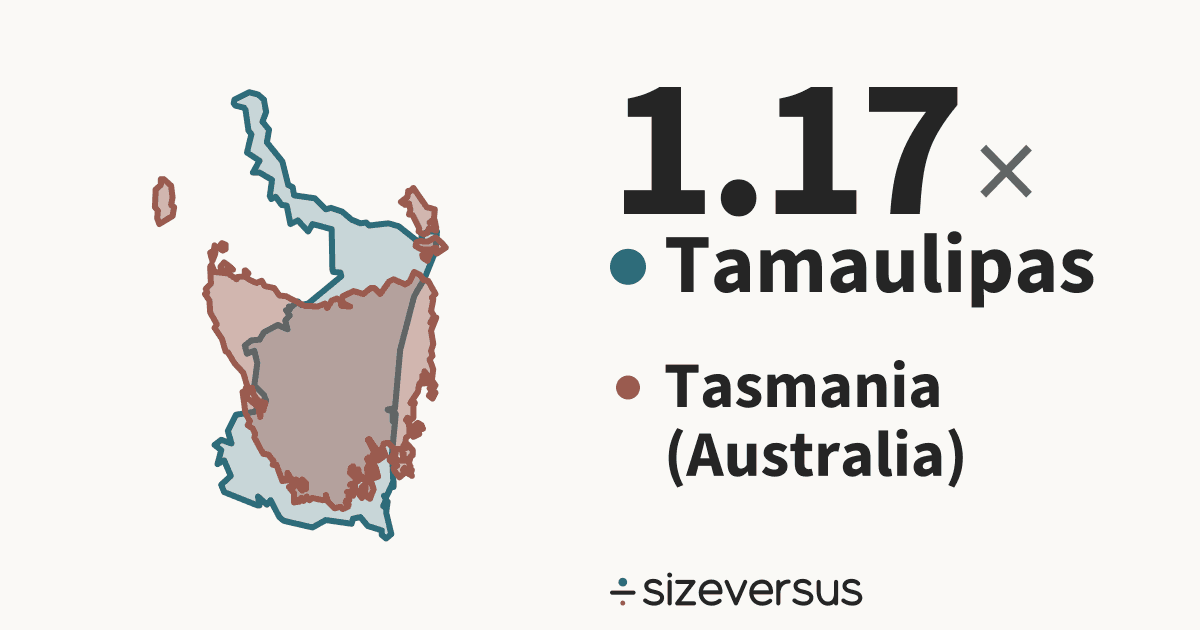
Tamaulipas is 1.17× the size of Tasmania (Australia)
Tamaulipas (state of Mexico) covers about 79,600 km² (30,700 mi²) and Tasmania (Australia) (state of Australia) about 68,100 km² (26,300 mi²). Below, both outlines are drawn at one scale and centred on each other.
- 79,600km²Tamaulipas
- 68,100km²Tasmania (Australia)
100 km
- Tamaulipas
- Tasmania (Australia)
What fits
- Tasmania (Australia) is 86% of the size of Tamaulipas.
- Tamaulipas is larger by 11,500 km² (4,430 mi²), which is 17% of the area of Tasmania (Australia).
- Measured in Belgiums: Tamaulipas is about 2.59, Tasmania (Australia) about 2.22.
How they differ
- Tamaulipas also has the larger population: 3.4 million against 540,000, 6.38× as many people.
- Per square kilometre that is 43 in Tamaulipas against 7.9 in Tasmania (Australia): Tamaulipas is 5.46× as densely populated.
- Their centres are about 13,800 km apart.
- On a standard web map Tasmania (Australia) looks larger than Tamaulipas: Tamaulipas at 24°N is drawn about 1.2× too large and Tasmania (Australia) at 42°S about 1.8×, so the map shows Tasmania (Australia) as 1.28× the size of Tamaulipas, when Tamaulipas is 1.17× the size of Tasmania (Australia).
- Together Tamaulipas and Tasmania (Australia) cover 148,000 km², close to the size of Nepal (147,000 km², 0.4% smaller).
- The gap between them, 11,500 km², is about the size of Falkland Islands (11,600 km²).
- At Tasmania (Australia)'s density, Tamaulipas would have 630,000 people (it has 3.4 million). At Tamaulipas's density, Tasmania (Australia) would have 2.9 million (it has 540,000).
- Tamaulipas's centre is 66.2° of latitude, about 7,360 km, farther north than Tasmania (Australia)'s.
- Tamaulipas is the 7th largest of the 32 states of Mexico and covers 4.1% of its area; it is the 22nd most densely populated of them.
- Tasmania (Australia) is the 7th largest of the 8 states and territories of Australia and covers 0.9% of its area; it is the 4th most densely populated of them.
- Tamaulipas lies about 66° of latitude (roughly 7,360 km) north of Tasmania (Australia), on the other side of the equator.
- Shared out evenly, each person in Tamaulipas would have about 23,120 m² and each person in Tasmania (Australia) about 126,230 m².
- Laid side by side, Tamaulipas and Tasmania (Australia) would cover 148,000 km², about the same size as Nepal.
- Together they have 4.0 million people, about as many people as Georgia.
Side by side
| Tamaulipas | Tasmania (Australia) | |
|---|---|---|
| Is a | StateMexico | StateAustralia |
| Area, measured | 79,600 km²30,700 mi² | 68,100 km²26,300 mi² |
| Official area | 80,200 km²Wikidata | 68,400 km²Wikidata |
| Rank by area | 7th of 32in Mexico | 7th of 8in Australia |
| Population | 3.4 millionWikidata, 2015 | 540,000Wikidata, 2020 |
| Rank by population | 13th of 32in Mexico | 6th of 8in Australia |
| Density | 43 per km² | 7.9 per km² |
| Capital | Ciudad Victoria | Hobart |
| Latitude range | 22°N to 28°N | 44°S to 40°S |
Population: Wikidata 2015 and Wikidata 2020. Official figures: Wikidata (CC0).
- Wikidata's official figure of 80,200 km² agrees with our measured area of 79,600 km², to within 2%.
- Wikidata's official figure of 68,400 km² agrees with our measured area of 68,100 km², to within 2%.
Similar in size to Tamaulipas
Similar in size to Tasmania (Australia)
More from the same country
More comparisons
- Tamaulipas vs Czechia
- Tamaulipas vs Serbia
- Austria vs Tamaulipas
- Tamaulipas vs Ireland
- Uruguay vs Tamaulipas
- Tamaulipas vs New Brunswick
- Chongqing vs Tamaulipas
- Mississippi vs Tasmania (Australia)
- Durango vs Tasmania (Australia)
- Fujian vs Tasmania (Australia)
- Louisiana vs Tasmania (Australia)
- Pennsylvania vs Tasmania (Australia)
Send it to someone who won’t believe it

Sources and method
- Outlines
- Natural Earth, 1:10m Admin 1 - States, Provinces, public domain
- Boundary
- De facto, as drawn by Natural Earth. A region is drawn whole, every island included; a country is its main territory.
- Area
- Measured on the WGS84 ellipsoid from the full-detail outlines, shown rounded.
- Drawing
- Each outline is projected with an equal-area projection centred on its own centroid, so areas stay true and the two can be laid over each other.
- Data built
- 2026-11-12