Island
Iceland (island)
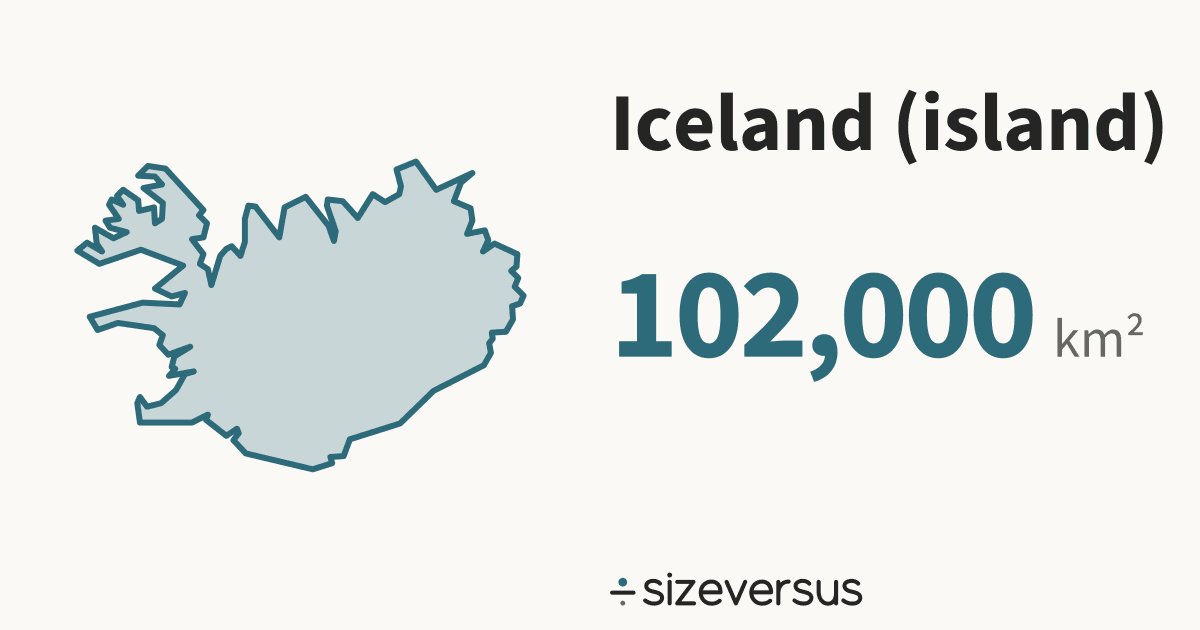
Natural Earth’s outline of Iceland (island) measures about 102,000 km² (39,300 mi²), the 17th largest of the 81 islands on sizeversus, and about the same size as Iceland.
100 km
- Iceland
- Iceland (island)
The numbers
- 102,000km²Area, measured39,300 mi² · Natural Earth outline
- 103,000km²Area, publishedWikidata · agrees within 2%
The area is measured from the outline drawn above, on the WGS84 ellipsoid; the published figure is shown beside it, and a water body is kept only if the two are within 10%.
What the numbers say about Iceland (island)
- Greenland (island), the largest of the 81 islands ranked on sizeversus, is 21.3× the size of Iceland (island); Iceland (island) ranks 17th.
- Iceland (island) sits between Luzon (103,000 km²) and Mindanao (92,000 km²) in the ranking.
- Counted as a country, Iceland (island) would be larger than 105 of the 212 countries listed on sizeversus and would rank 108th by area, between Iceland (102,000 km²) and South Korea (98,500 km²).
- It is larger than 14 of the 51 US states and districts (the biggest of them is Indiana, 94,300 km²) and smaller than 37.
- It is larger than 8 of the 31 provinces and regions of China (the biggest of them is Zhejiang, 101,000 km²) and smaller than 23.
- The closest Chinese province is Zhejiang (101,000 km²): Iceland (island) is about the same size as Zhejiang.
- On a standard web map (Web Mercator), a place at 65°N is drawn about 5.6× too large in area, so Iceland (island) looks bigger there than it is.
- Laid out flat, Iceland (island) stretches about 349 km north to south and 506 km east to west.
- Wikidata’s published figure of 103,000 km² agrees with our measured 102,000 km², to within 2%.
About the same size as
Countries
Where it lies
Natural Earth’s outlines of Iceland contain or lie within 4 km of the outline of Iceland (island). That is what its geometry says, and it is not a statement about who owns the water or where any border runs in it.
Where Iceland (island) ranks
Iceland (island) is the 17th largest of the 81 islands on sizeversus, ranked by measured area.
Ranked islands
Compare Iceland (island)
Share this outline

Sources and method
- Outline
- Natural Earth, 1:10m Geography Regions (geography_regions_polys), public domain (Geography Regions (geography_regions_polys)). Outlines of lakes are drawn at 1:10 million.
- Boundary
- A lake or a sea has no legal boundary of its own. The outline is a cartographic one, and the page says so by showing the measured area beside the published one.
- Area basis
- Measured outline: computed on the WGS84 ellipsoid from the full-detail outline and shown rounded. Published figure: Wikidata (CC0), fetched 2026-11-11. An outline is kept within 10% of the published figure and matched to other places automatically within 5%.
- Shore
- Countries whose Natural Earth outline contains or comes close to the water's outline; computed, not a statement of ownership.
- Drawing
- Each outline is projected with an equal-area projection centred on its own centroid, so areas stay true and two can be laid over each other.
- Data built
- 2026-11-11