Lake
Khar-Us Lake
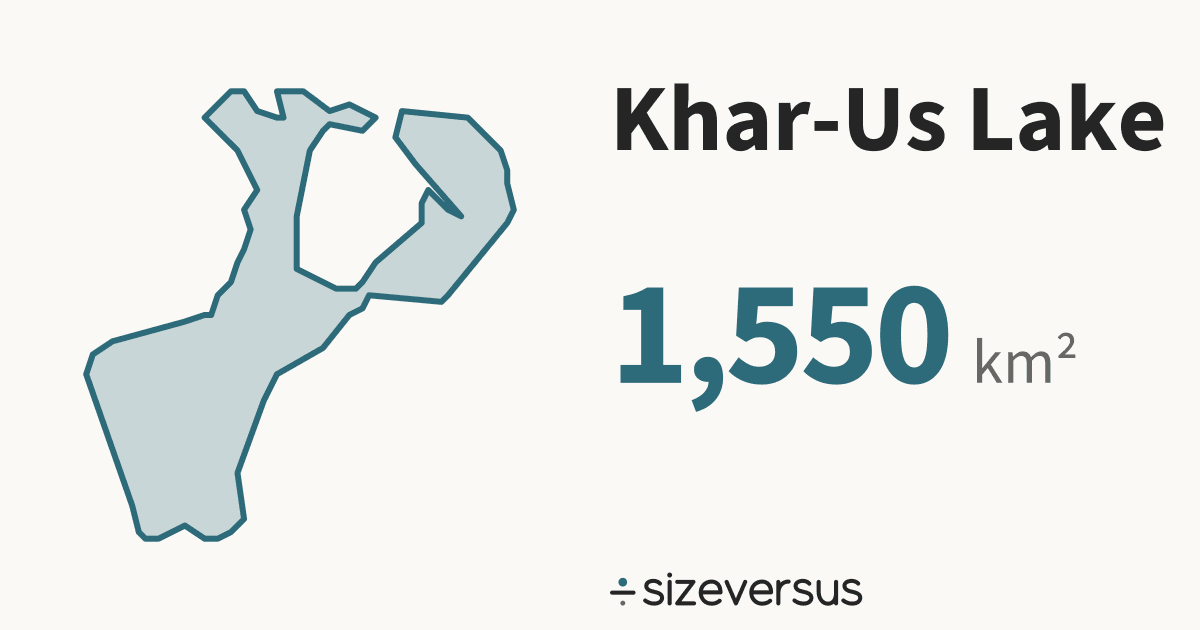
Natural Earth’s outline of Khar-Us Lake measures about 1,550 km² (600 mi²), the 69th largest of the 104 lakes on sizeversus, and 93% of the size of the Comoros.
50 km
- Comoros
- Khar-Us Lake
The numbers
- 1,550km²Area, measured600 mi² · Natural Earth outline
- 1,580km²Area, publishedWikidata · agrees within 2%
- 4.5mGreatest depthaverage about 2 m
- 3.1km³VolumeWikidata
- 1,157mAbove sea levelSurface, Wikidata
The area is measured from the outline drawn above, on the WGS84 ellipsoid; the published figure is shown beside it, and a water body is kept only if the two are within 10%.
What the numbers say about Khar-Us Lake
- The Caspian Sea (called a sea or a lake, depending on the definition), the largest of the 104 lakes ranked on sizeversus, is 244× the size of Khar-Us Lake; Khar-Us Lake ranks 69th.
- Khar-Us Lake sits between Siling Lake (1,580 km²) and Lac Seul (1,520 km²) in the ranking.
- Counted as a country, Khar-Us Lake would be larger than 35 of the 212 countries listed on sizeversus and would rank 178th by area, between the Comoros (1,670 km²) and São Tomé and Príncipe (1,040 km²).
- It is larger than 1 of the 51 US states and districts (the biggest of them is Washington, D.C., 162 km²) and smaller than 50.
- It is smaller than every one of the 31 provinces and regions of China.
- The closest US state is Rhode Island (2,830 km²): Khar-Us Lake is 55% of the size of Rhode Island.
- Wikidata records a greatest depth of 5 m; with its volume that gives an average depth of about 2.0 m.
- Wikidata records a volume of 3 km³. Poured over the Comoros (1,670 km²), that water would stand 1.9 m deep.
- Its surface lies about 1,157 m above sea level (Wikidata).
- On a standard web map (Web Mercator), a place at 48°N is drawn about 2.2× too large in area, so Khar-Us Lake looks bigger there than it is.
- Laid out flat, Khar-Us Lake stretches about 68 km north to south and 64 km east to west.
- Wikidata’s published figure of 1,580 km² agrees with our measured 1,550 km², to within 2%.
About the same size as
Countries
US states
On the shore
Natural Earth’s outlines of Mongolia contain or lie within 4 km of the outline of Khar-Us Lake. That is what its geometry says, and it is not a statement about who owns the water or where any border runs in it.
Names
- Khar-Us Lakethe name in this page’s titlesource: Wikidata’s English label
- Khar-Usalso calledsource: Natural Earth
- Har Us Nuuralso calledsource: Natural Earth
Where Khar-Us Lake ranks
Khar-Us Lake is the 69th largest of the 104 lakes on sizeversus, ranked by measured area.
Share this outline

Sources and method
- Outline
- Natural Earth, 1:10m Lakes + Reservoirs, public domain (Lakes + Reservoirs). Outlines of lakes are drawn at 1:10 million.
- Boundary
- A lake or a sea has no legal boundary of its own. The outline is a cartographic one, and the page says so by showing the measured area beside the published one.
- Area basis
- Measured outline: computed on the WGS84 ellipsoid from the full-detail outline and shown rounded. Published figure: Wikidata (CC0), fetched 2026-11-11. An outline is kept within 10% of the published figure and matched to other places automatically within 5%.
- Depth, volume, height
- As recorded in Wikidata; a volume that cannot be right for the area and depth is left out.
- Shore
- Countries whose Natural Earth outline contains or comes close to the water's outline; computed, not a statement of ownership.
- Drawing
- Each outline is projected with an equal-area projection centred on its own centroid, so areas stay true and two can be laid over each other.
- Data built
- 2026-11-11