Province of Canada
Quebec
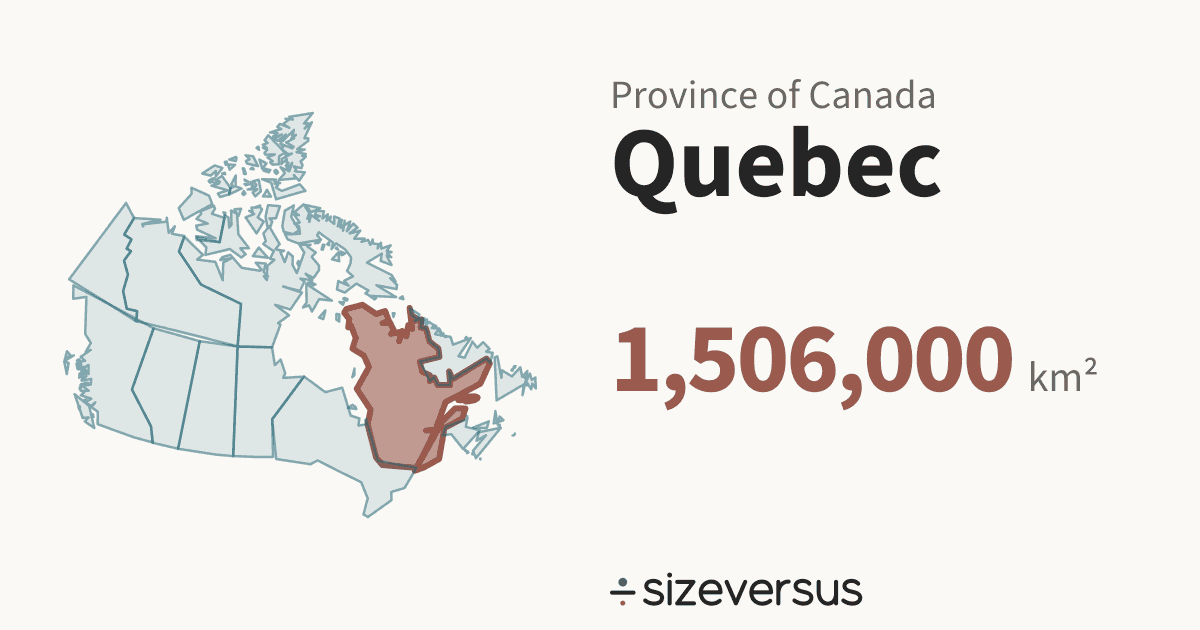
Quebec is a province of Canada. It covers about 1,506,000 km² (581,000 mi²), the 2nd largest of the 13 provinces and territories in Natural Earth’s file for Canada, and 96% of the size of Mongolia. About 8.5 million people live there (Wikidata, 2021).
500 km
- Mongolia
- Quebec
Facts
| Area, measured | 1,506,000 km²581,000 mi² |
|---|---|
| Official area | 1,542,000 km²Wikidata · 2.4% above our measure |
| Share of Canada | 15%of the area of the 13 provinces and territories |
| Rank by area | 2nd of 13provinces and territories of Canada |
| Population | 8.5 millionWikidata, 2021 · the census year of every unit |
| Density | 5.6 people per km² |
| Capital | Quebec City |
| Latitude range | 45°N to 63°N |
| Type | ProvinceCA-QC |
What the numbers say about Quebec
- Quebec covers 15% of the area of Canada and ranks 2nd of 13 by both area and population.
- It would take 6.61 provinces and territories the size of Quebec to cover Canada.
- Quebec holds 23% of the 37.0 million people that Wikidata’s 2021 figures give for the 13 provinces and territories together: about 1 in 4.
- The largest, Nunavut, is 1.38× the size of Quebec; the smallest, Prince Edward Island, is 0.4% of it.
- Closest in size within Canada: Northwest Territories (1,348,000 km², 1.12×) and Nunavut (2,080,000 km², 1.38×).
- Counted as a country, Quebec would be larger than 220 of the 239 countries and territories listed on sizeversus, and would rank 20th by area, between Mongolia (1,565,000 km²) and Peru (1,290,000 km²).
- With 8.5 million people it would rank 100th of 238 by population.
- Quebec has 5.6 people per km², about the density of Mauritania, which has 4.6 per km².
- That makes Quebec the 6th most densely populated of the 13 provinces and territories, 1.52× the average for Canada (3.7 per km²).
- On a standard web map (Web Mercator), a place at 53°N is drawn about 2.8× too large in area, so Quebec looks bigger there than it is.
- Laid out flat, Quebec stretches about 1,960 km north to south and 1,600 km east to west.
- Our measured 1,506,000 km² is 2.4% below Wikidata's official figure of 1,542,000 km². Official figures can include inland water or count land that an outline draws differently.
About the same size as
Beside the regions of other countries
The closest region by area and by people in each of the other countries that have regional pages here, within a factor of 2. All 395 regions side by side.
- ChinaAreaXinjiang0.92× · 1,630,000 km²PeopleNingxia1.18× · 7.2 million (2020)
- United StatesAreaAlaska1.00× · 1,505,000 km²PeopleVirginia0.98× · 8.6 million (2020)
- IndiaAreanone within 2×PeopleUttarakhand84% · 10.1 million (2011)
- GermanyAreanone within 2×PeopleLower Saxony1.07× · 7.9 million (2022)
- FranceAreanone within 2×PeopleAuvergne-Rhône-Alpes1.04× · 8.2 million (2022)
- ItalyAreanone within 2×PeopleLombardy84% · 10.1 million (2019)
- SpainAreanone within 2×PeopleAndalusia0.99× · 8.6 million (2024)
- JapanAreanone within 2×PeopleOsaka0.96× · 8.8 million (2021)
- BrazilAreaAmazonas0.96× · 1,565,000 km²PeopleCeará0.97× · 8.8 million (2022)
- AustraliaAreaNorthern Territory1.12× · 1,348,000 km²PeopleNew South Wales0.99× · 8.5 million (2024)
- MexicoAreanone within 2×PeopleVeracruz1.05× · 8.1 million (2015)
- ThailandAreanone within 2×PeopleBangkok1.50× · 5.7 million (2018)
Where Quebec sits in Canada
All 13 drawn on one equal-area map, so sizes are comparable. Select another to open it.
Compare Quebec
Share this outline

Sources and method
- Outline
- Natural Earth, 1:10m Admin 1 - States, Provinces, public domain
- Boundary
- De facto, as drawn by Natural Earth.
- Area
- Measured on the WGS84 ellipsoid from the full-detail outline, shown rounded. The region’s whole area is counted, every island included.
- Official figures
- Area, population and capital from Wikidata (CC0), fetched 2026-11-12
- Population
- Wikidata, 2021. Canada’s units share the 2021 figures where Wikidata has them; the year is shown wherever the figure is.
- Matching
- Countries come from Natural Earth’s country file. Places whose status is contested and dependencies are never used as automatic matches. A region under 2,500 km² is matched against the small countries and island nations.
- Data built
- 2026-11-12